Innovation — 251 insights
Smart-driving chips: the weapon of choice in China’s EV tech war
Innovation

Smart-driving chips: the weapon of choice in China’s EV tech war

Carmakers strive for more control over computing hardware to reduce reliance on Nvidia and Horizon Robotics A new front has opened in China’s electric-vehicle tech war as carmakers design their own smart-driving chips, turning custom silicon into the industry’s weapon of choice in the world’s largest auto market. The latest salvo came on Monday after Li Auto unveiled the Mach M100, a 5-nanometre artificial-intelligence chip tailored for autonomous driving. The announcement followed a string of breakthroughs by its rivals. Higher TOPS allow a vehicle’s computers to make split-second driving decisions by simultaneously crunching feeds from various sources such as radar and lidar sensors.

Motorsport new battleground for Chinese carmakers as Geely and BYD rev up global drive
Innovation

Motorsport new battleground for Chinese carmakers as Geely and BYD rev up global drive

Billionaire Li Shufu, owner and chairman of Geely Auto, China’s second-largest carmaker, plans to bring the Superbike World Championship (WSBK) to the country, banking on the success of a home-grown motorcycle brand in competition. The move marked Geely’s latest step to sharpen its image as an international marque with advanced technologies and new models, according to analysts. Li and Zhang Xue, owner of ZXMOTO, agreed to jointly promote China’s hosting of the WSBK during their appearance on...

‘Ni hao, Ah Bao’: China’s Alipay gets AI-agent overhaul to challenge big tech rivals
Innovation

‘Ni hao, Ah Bao’: China’s Alipay gets AI-agent overhaul to challenge big tech rivals

Fintech giant is seen leveraging its billion-user base to launch a conversational interface that coordinates 10,000 services, with safeguards Ant Group has unveiled the biggest overhaul of Alipay in two decades, transforming its ubiquitous mobile-payment app into a native AI platform with autonomous agents, as it strives to dominate China’s next-generation internet gateway. A trial version of the flagship app now features an interactive assistant named “Ah Bao”, marking a strategic pivot from a traditional digital wallet into an AI-driven ecosystem. Accessible via a right swipe on the homepage, the new interface allows users to access more than 10,000 everyday services – from ride-hailing to food delivery – through conversations with the Ah Bao bot. The feature is currently available on an invite-only basis, with plans for a gradual roll-out to all users, according to Alipay. To address potential security concerns inherent to autonomous artificial intelligence, Alipay said Ah Bao acts strictly as a process operator. All final payments and other financial actions were said to require explicit confirmation from users to prevent unauthorised transactions.

AI for less: price war in China deepens amid ‘intense’ competition
Innovation

AI for less: price war in China deepens amid ‘intense’ competition

Narrowing capability gaps between models and falling costs of service set stage for price reductions to continue, analysts say TikTok parent ByteDance and Shenzhen-based video gaming giant Tencent Holdings are the latest to launch AI price offensives. “China’s AI model landscape is vibrant and intensely competitive, with limited capability gaps across incumbents,” said analysts from investment consultancy Bank of America Securities in a research note on Monday. ByteDance on Monday introduced Seedance 2.0 Mini, a video-generation model, with a price of 23 yuan (US$3.40) for 1 million tokens – half the price of the standard version of the popular model. The move followed a promotional campaign that offered rebates to users of its Coze AI agent platform. With its lower pricing, ByteDance joined AI rivals including Chinese frontier lab DeepSeek and smartphone-to-vehicle giant Xiaomi. Both cut prices in late May, with Xiaomi making its MiMo V2.5 model 99 per cent cheaper, triggering other frontier labs to follow. Tencent last week cut prices for certain existing models on its TokenHub platform, slashing the cost of its own Hy-MT2-Pro by nearly 70 per cent.

Alibaba eyes physical world with its first suite of AI models for robots
Innovation

Alibaba eyes physical world with its first suite of AI models for robots

Alibaba unveils Qwen robot models to push AI beyond chatbots, as embodied intelligence becomes the next frontier in global AI Alibaba Group Holding has launched its first suite of artificial intelligence models for robots, joining a global race to move AI out of chatbot windows and into the physical world. The Hangzhou-based tech giant on Tuesday introduced the Qwen Robot Suite, marking its latest foray into “embodied AI” – machines that can perceive, reason and interact with physical environments. Developed by Alibaba’s AI research unit, Tongyi Lab, the suite has already entered pilot testing with selected Alibaba Cloud enterprise clients, according to the company. The suite splits robot intelligence into three interconnected layers. Qwen-RobotNav, a vision-language navigation model, is designed to help machines understand and move through physical spaces. It works in tandem with Qwen-RobotWorld, a video “world model” that lets robots predict and simulate how physical scenes will evolve before they take action. Then the physical execution is handled by Qwen-RobotManip, a generalist vision-language-action (VLA) model built on the Qwen3.5-4B architecture.

AI’s next frontier, world models, and why China is ahead of the pack
Innovation

AI’s next frontier, world models, and why China is ahead of the pack

They’ve been described as the “next frontier” of artificial intelligence (AI) – world models that go beyond large language models (LLMs) by simulating the physical environment. And in this emerging field, China has an edge over the United States. World models that understand the physical laws of the universe are already being used to train AI systems with embodied intelligence such as robots and self-driving vehicles. China has deployed such systems far more widely than the US – and this month,...

AI agents face trust issues in ‘high-risk’ industrial sectors: experts
Innovation

AI agents face trust issues in ‘high-risk’ industrial sectors: experts

Expert says large language models struggle in professional domains due to lack of industrial data and knowledge during training China’s industrial sectors are racing to integrate artificial intelligence to boost efficiency, bolstered by state support, but experts warn that critical vertical markets – such as healthcare and aerospace – may be too “high risk” for the shift towards autonomous agents. Hailed as the driver of a “fourth industrial revolution”, AI is shifting away from chatbots to agentic AI – systems capable of independent execution within a workflow, industry experts said at the International Data Corporation (IDC) CIO Summit in Shenzhen on Friday. Upper-layer software, which includes consumer-facing apps and internal management systems, will be “entirely replaced by agents”, said Liu Xiangyang, chief information security officer of Midea Group, as these agents are designed to understand business logic and execute workflows “In the future, 90 per cent of an AI agent’s value will come from industrial expertise,” said Du Yanze, senior research manager at IDC.

AI’s World Cup debut: real-time data poised to reshape football strategy, level the field
Innovation

AI’s World Cup debut: real-time data poised to reshape football strategy, level the field

From pressing patterns to offside calls, football’s grandest stage will showcase how instant analysis transforms decisions in heat of play Each team will have access to its own AI model, allowing analysts to compare playing patterns through video clips and 3D avatars. Coaches will be able to assess how tactical changes might work against their next opponents, while players will receive personalised match analysis. The system, known as “Football AI Pro”, can analyse hundreds of millions of Fifa data points and process more than 2,000 football-related metrics, including pressing, movement, tactics and transitions. It delivers insights as text explanations, charts or short video clips, and was developed by Lenovo, Fifa’s technology partner for the tournament. “If in the past rich teams had an advantage, in 2026 AI will democratise data and give everyone a similar chance,” Bank of America Global Research wrote in a May 6 note. Jointly hosted by Canada, Mexico and the United States across 16 cities, the 2026 Fifa World Cup will feature an expanded format of 48 teams and 104 matches. The opening game is scheduled for June 11.

Anthropic’s plea for US to grow its AI edge over China is ‘irresponsible’: analysts
Innovation

Anthropic’s plea for US to grow its AI edge over China is ‘irresponsible’: analysts

American firm’s warning about China’s tech capability seen by some as fearmongering as hopes of bilateral cooperation on AI safety rise Anthropic has urged the US to widen its edge over China in artificial intelligence capability to “avoid authoritarian AI leadership”, a warning which is being criticised by some industry experts as “irresponsible” and self-serving. Anthropic said that locking in a 12-to-24-month lead in frontier capabilities by 2028 would be “enormously advantageous”. This gap would allow the US to increase its engagement with AI experts in China in areas such as AI safety and governance, according to Anthropic. The prospect of the Communist Party leading in frontier AI is “among the greatest threats” to the future of humanity, “enabling repression at a scale that humans alone could not achieve”, Anthropic wrote. Anthropic, developer of the cutting-edge Claude models, is known to be a vocal critic of China’s AI advancement and a strong advocate for US chip export control measures.

China’s tech companies are looking to rewrite the e-commerce playbook with AI agents
Innovation

China’s tech companies are looking to rewrite the e-commerce playbook with AI agents

The nation’s over 900 million e-commerce users are taking part in an experiment where rigid search terms are replaced by natural dialogue For years, online shopping in China has followed a rigid, tedious ritual: typing precise keywords, squinting at endless rows of listings, and falling into a rabbit hole of product comparisons. But for a man surnamed Liu, a 30-something finance professional based in Hong Kong, that experience has recently evolved into something more akin to a casual conversation. Chatting with Alibaba Group Holding’s Qwen artificial intelligence assistant, Liu found that he was being offered a few curated choices rather than just a wall of products. “It lowers the decision-making burden,” he said, highlighting the AI assistant’s ability to “refine recommendations through flowing conversation”. Liu is one of China’s over 900 million e-commerce users taking part in what has become a massive nationwide retail experiment. Tech companies are racing to replace the rigid, traditional search bar with agentic AI, a move aimed at transforming online shopping from the previous routine of manual clicks into a more streamlined, natural dialogue.

‘Panic’ over capacity crunch in mature node chips drives orders to Chinese foundries
Innovation

‘Panic’ over capacity crunch in mature node chips drives orders to Chinese foundries

AI demand shifts chip production to China, boosting SMIC’s capacity and revenue as global foundries focus on high-margin AI chips The global AI boom is driving orders back to Chinese foundries as overseas rivals shift production towards high-margin AI chips and high-bandwidth memory, creating a shortage in mature-node semiconductors, according to the head of China’s top contract chipmaker. Zhao noted that the squeeze was prompting consumer electronics and IoT customers to seek capacity in mainland China – a trend reinforced by electric vehicle demand, a robotics boom, domestic supply-chain localisation, and companies stockpiling. His comments align with broader market data. The average utilisation rate for older generation 8-inch wafers at the world’s top 10 foundries was expected to hit nearly 90 per cent in 2026, up from 80 per cent in 2025, according to TrendForce. The rebound is driven by surging demand for power management integrated circuits (PMICs) used in AI servers. With global leader Taiwan Semiconductor Manufacturing Company (TSMC) planning to reduce some 12-inch mature-node capacity, Chinese suppliers and second-tier foundries are absorbing the overflow, the research firm said.

Meet Zhou Qunfei: the woman seated between Tim Cook and Elon Musk at China state banquet
Innovation

Meet Zhou Qunfei: the woman seated between Tim Cook and Elon Musk at China state banquet

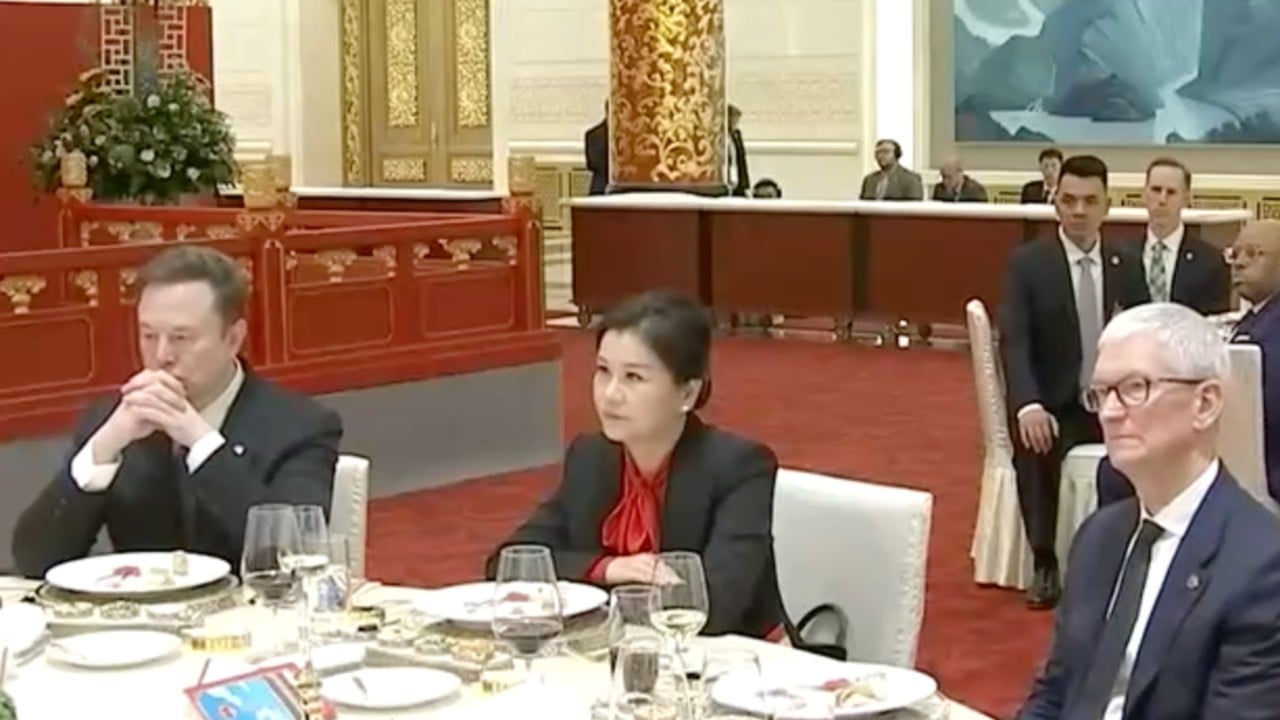
The chairwoman of manufacturing giant Lens is one of the country’s richest self-made women, working her way up from Shenzhen’s factory floors Several Chinese business leaders attended the banquet alongside US executives and officials, including Hisense chairman Jia Shaoqian, Wanxiang Group chairman Lu Weiding, Fuyao Glass chairman Cao Hui, Air China chairman Liu Tiexiang, Comac chairman He Dongfeng, Lenovo chairman Yang Yuanqing, Xiaomi founder Lei Jun, Haier chairman Zhou Yunjie, and ByteDance chief executive Liang Rubo, according to footage broadcast by CCTV and media reports. Partnering with Apple, the company took off. Lens won a spot in Apple’s supply chain in 2007 as a cover glass provider, just as the iPhone was about to reshape the smartphone industry. As the iPhone scaled globally, Apple became Lens’s largest customer, accounting for more than half of its annual revenue in the early 2010s. Lens listed on Shenzhen’s tech-heavy ChiNext Index in March 2015, making Zhou one of China’s richest self-made women. The company went public in Hong Kong in 2025. Lens’s Shenzhen-listed shares closed at 32.21 yuan on Friday, up nearly 5.9 per cent, valuing it at 180.6 billion yuan (US$26.6 billion).