Innovation — 258 insights
Open-weight Chinese AI models gain foothold in Europe despite Brussels’ trepidation
Innovation

Open-weight Chinese AI models gain foothold in Europe despite Brussels’ trepidation

Chinese models will be ‘significant’ for European firms, as their ‘performance and efficiency are increasingly competitive’, analyst says European businesses are increasingly weighing whether cheap but capable Chinese artificial intelligence systems represent a new threat to the continent’s technological sovereignty or a practical tool to strengthen it. While using Chinese technology might seem counterintuitive to Europe’s goals, running open-weight Chinese models on local servers can actually give firms greater operational control than relying on proprietary US services, according to a Germany-based consultant. “A Chinese-developed open-weight model operated on European infrastructure, with data remaining under the company’s control, may in some respects offer greater operational sovereignty than consuming a proprietary foreign [model] that can be changed, repriced or withdrawn remotely,” said Volker Pfirsching, a Munich-based partner at management consultancy Arthur D. Little, in an interview this week. “Sovereignty should not simply be equated with the nationality of the supplier,” Pfirsching said.

Launch of DeepSeek’s Harness marks its strategic pivot towards autonomous agentic AI
Innovation

Launch of DeepSeek’s Harness marks its strategic pivot towards autonomous agentic AI

With the launch of Harness, China’s DeepSeek continues to build the foundational digital scaffolding for autonomous AI agents The release on Thursday marks a strategic pivot as DeepSeek moves to build foundational digital scaffolding for AI agents – systems capable of using AI models to operate external software, run code, and complete complex jobs on their own. Tools like DeepSeek Harness are rapidly becoming an important layer in AI systems, shifting the global competition from model intelligence to one that focuses on how seamlessly an AI agent can connect to real-world software. To cater to different enterprise and developer workloads, DeepSeek Harness provides four operational settings. These include a standard mode for general tasks, a code-focused mode that lets the AI write code to command multiple applications simultaneously, a creative mode that allows the system to experiment with custom tools, and a minimal mode for isolated testing.

China’s richest province taps Alibaba to power its AI and chip push
Innovation

China’s richest province taps Alibaba to power its AI and chip push

Guangdong province deepens ties with China tech giant to boost digital innovation by focusing on AI, semiconductors and smart services Under a strategic cooperation framework agreement signed on Thursday in Guangzhou, capital of Guangdong province in southern China, the Hangzhou-based firm planned to increase its investments in computing power, AI models and digital services, according to a report by local state media Nanfang Daily. Provincial party secretary Huang Kunming thanked Alibaba “for its long-standing support of Guangdong’s economic and social development” and urged the company to “step up efforts in technology innovation, research development and investment” in the region, according to the report. He highlighted potential synergies with energy and telecommunications companies to strengthen computing power in Guangdong, alongside the deployment of AI models across consumer electronics, manufacturing equipment and healthcare. Huang added that local goods could be further promoted through Alibaba’s online shopping and cross-border e-commerce platforms.

SMIC eyes expansion amid AI boom, Zhu Rongji dies, Shein nears IPO
Innovation

SMIC eyes expansion amid AI boom, Zhu Rongji dies, Shein nears IPO

SMIC, China’s biggest contract chipmaker, is planning to boost capacity after beating earnings expectations amid the artificial intelligence (AI) boom. Demand is “far exceeding our previous expectations”, so the company is adjusting expansion plans and may add more equipment at existing sites, chief executive officer Zhao Haijun said on an earnings call on Friday. He didn’t provide details. The chipmaker’s shares gained 4.8 per cent in Hong Kong trading after it more than tripled second-quarter...

Rich Chinese embrace domestic high-end EVs as tech and driving experience eclipse prestige
Innovation

Rich Chinese embrace domestic high-end EVs as tech and driving experience eclipse prestige

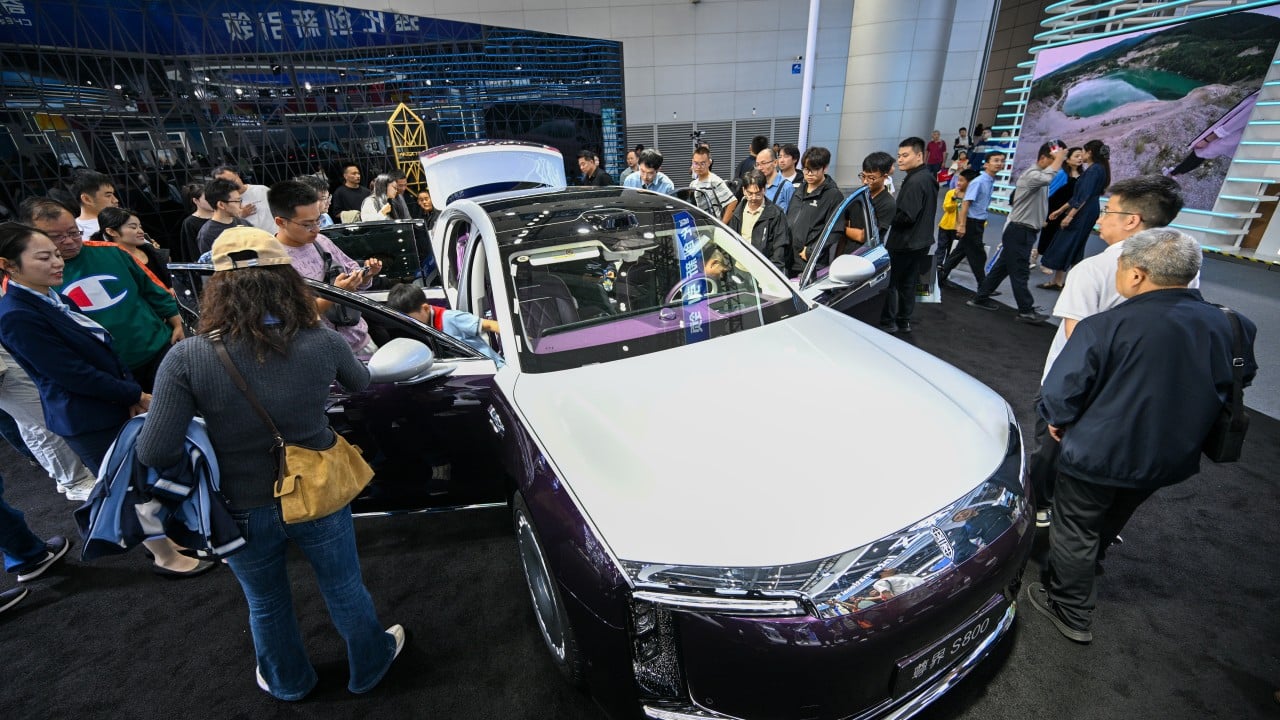
Younger, professionally diverse Chinese are turning to local brands for technology and qualities once tied to foreign marques His next purchase, he said, would be a six-seat premium electric minivan equivalent from a Chinese brand, with a budget of about 1 million yuan (US$148,000). Huang’s choice shows that even while China’s ultra-luxury car market has slowed overall, a growing segment of drivers, with a penchant for domestic brands, are still opening their wallets for top-end EVs. A report by Beijing-based consultancy Guanyan Tianxia on China’s luxury car market and investment from 2025 to 2032 said Chinese luxury-car buyers were becoming younger and more professionally diverse, with technology and driving experience increasingly outweighing the prestige of traditional luxury names.

SMIC weighs more capacity as AI-related chip demand exceeds forecasts
Innovation

SMIC weighs more capacity as AI-related chip demand exceeds forecasts

China’s largest foundry says shortages are spreading to mature-node chips, with some AI-driven demand visible through the end of 2027 Semiconductor Manufacturing International Corporation (SMIC) is actively looking at adding equipment in its factories after demand for mature-node chips used alongside AI processors surged beyond expectations, according to company management. “Future wafer starts are far exceeding our previous expectations,” co-CEO Zhao Haijun said during an earnings call, referring to the volume of new chip batches entering the production line. Zhao said SMIC was adjusting its expansion plans and may install additional equipment at existing sites where space was available, with further details to be disclosed in upcoming announcements or briefings. Demand was particularly strong for supporting chips in AI servers and data centres – including logic chips, power-management products and optical module components. Orders for BCD (bipolar-CMOS-DMOS) power-management products were visible through the end of 2027, Zhao added.

DeepSeek’s updated V4 Pro AI model struggles on benchmarks, shines in cybersecurity
Innovation

DeepSeek’s updated V4 Pro AI model struggles on benchmarks, shines in cybersecurity

Chinese AI start-up’s model impresses in niche areas like cybersecurity but leaves some developers disappointed in its overall capabilities Chinese artificial intelligence start-up DeepSeek has quietly released DeepSeek-V4-Pro-0813, an updated version of its latest flagship model, leaving some developers underwhelmed by its overall capabilities and disappointed in its pricing – but impressing researchers in niche areas like cybersecurity. However, early benchmark results suggest the new flagship is struggling to match its top-tier rivals. DeepSeek-V4-Pro-0813 scored 53 on the Artificial Analysis Intelligence Index, on par with Zhipu AI’s GLM-5.2 released in June, but was four points behind the mid-tier Terra model in OpenAI’s latest GPT-5.6 series and seven points behind Moonshot AI’s Kimi K3. On the Vals Index, compiled by San Francisco-based Vals AI to evaluate models across several benchmarks, the new DeepSeek model ranked 12th. It trailed OpenAI’s previous-generation GPT-5.5 and also lagged well behind frontier systems like Kimi K3 and Anthropic’s Claude Opus 5.

China’s YMTC breaks into global top 3 flash-memory suppliers with 14% market share
Innovation

China’s YMTC breaks into global top 3 flash-memory suppliers with 14% market share

The chipmaker captured a larger proportion of bit shipments, but still ranks fifth by revenue due to heavier exposure to lower-value products Yangtze Memory Technologies Corporation (YMTC) has broken into the world’s top three NAND flash memory suppliers by volume for the first time, marking a milestone for China’s semiconductor ambitions as it strives to narrow the revenue gap with global rivals in high-value data-centre storage. The Wuhan-based chipmaker captured 14 per cent of global NAND bit shipments – a measure of total storage capacity shipped rather than total chip units – in the second quarter, narrowly overtaking Japan’s Kioxia, according to data from Counterpoint Research published on Wednesday. Samsung Electronics retained the global lead with a 25 per cent market share, while SK Hynix – including its Solidigm subsidiary – was second at 22 per cent. YMTC’s shipments climbed 22 per cent year on year and 5 per cent quarter on quarter, driven by expanding supplies to domestic electronics manufacturers and the increased production of its latest-generation 3D NAND architecture, Counterpoint said. Despite its surge in shipment volume, YMTC’s market position lags in dollar terms.

Honor’s new Robot Phone looks to boost global appeal with its nodding camera
Innovation

Honor’s new Robot Phone looks to boost global appeal with its nodding camera

The Chinese smartphone maker has integrated embodied AI to control camera movement, along with other features to boost interest amid a cooling market Chinese smartphone maker Honor has launched a handset with a motorised robotic camera that nods back at users, betting that its interactive hardware will spark growth in a cooling global market for the devices. Beyond standard artificial intelligence agentic capabilities that execute tasks across apps, the Robot Phone uses embodied AI to enhance physical video performance. It is designed to automatically pan and tilt the gimbal camera to keep users in the frame as they move about during phone calls or live streams. And in a bid to woo mobile filmmakers, Honor has partnered with German cinema camera maker Arri to power the handset’s imaging technology. The Robot Phone is slated to go on sale in mainland China on Tuesday, with prices starting at 9,999 yuan (US$1,482), according to the company.

Tencent capex jumps 176% on AI push as revenue beats estimates
Innovation

Tencent capex jumps 176% on AI push as revenue beats estimates

The firm’s second-quarter revenue surpassed market projections at US$30.4 billion, but the surge in AI spending led to a large negative free cash flow Tencent Holdings nearly tripled its capital spending in the second quarter to supercharge its AI push, as accelerating investments in computing power and models helped drive better-than-expected revenue. Revenue for the quarter ending in June reached 204.8 billion yuan (US$30.4 billion), up 11 per cent year on year from 184.5 billion yuan, the Chinese tech giant reported on Wednesday. The figure beat average analyst estimates of 202.8 billion yuan compiled by Bloomberg. Adjusted net income reached 68.4 billion yuan, in line with consensus estimates of 68.2 billion yuan and up from 63.1 billion yuan in the same period last year. “As we enter into the third quarter of the year, we are making substantial progress towards building a new, AI-empowered Tencent in terms of intelligence, applications and infrastructure,” said Pony Ma Huateng, Tencent’s co-founder, chairman and CEO, in a statement. Before the earnings release, Tencent shares closed down 1.95 per cent at HK$461.6 (US$58.82) in Hong Kong trading on Wednesday.

Zuckerberg cites China threat to US lead in AI manifesto
Innovation

Zuckerberg cites China threat to US lead in AI manifesto

Meta Platforms CEO Mark Zuckerberg published a 6,500-word essay outlining his vision for artificial intelligence (AI), backing development of open-weight models and arguing that overregulation risks surrendering US leadership to China. “American communities will have greater prosperity and security if America and its allies lead in AI compared to geopolitical rivals,” the Facebook billionaire wrote in the essay, which was published on Monday. Still, the US faces a “significant disadvantage” as...

Meta to challenge China’s open-weight AI dominance amid US regulatory fears
Innovation

Meta to challenge China’s open-weight AI dominance amid US regulatory fears

China’s dominance in open-weight artificial intelligence faces a fresh challenge from Meta Platforms, whose renewed push into open-source models could lure away American customers anxious about looming regulatory restrictions in Washington, analysts say. The US tech giant on Monday launched Muse Glimmer, a 30-billion-parameter open-weight model light enough to run locally on personal computers, while also announcing plans to release the weights of its latest flagship Muse Spark 1.2 model. In a...