Innovation — 134 insights
Chinese AI chip start-up exits stealth mode, bets on 3D stacking to bypass US controls
Innovation

Chinese AI chip start-up exits stealth mode, bets on 3D stacking to bypass US controls

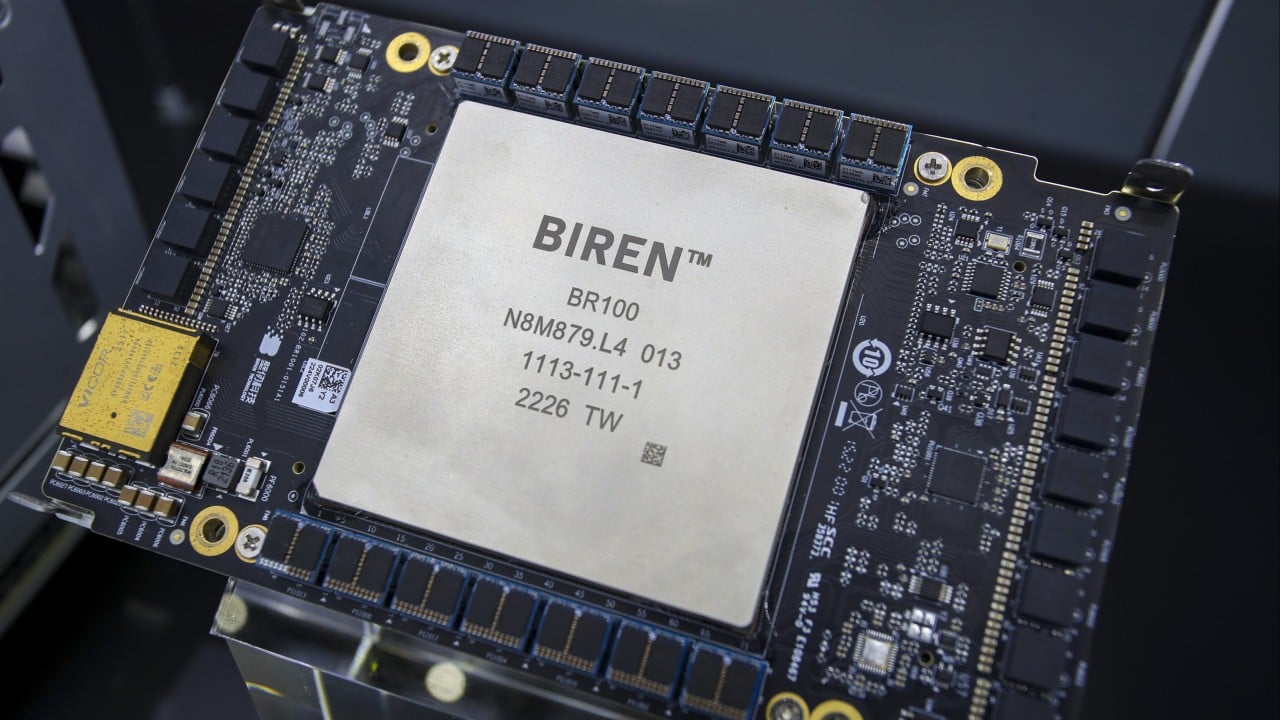
Dongfang Suanxin is headed by Wei Shaojun, who is also vice-president of the China Semiconductor Industry Association A Chinese artificial intelligence chip start-up led by industry veteran Wei Shaojun has emerged from stealth mode, joining giants like Huawei Technologies in betting on 3D stacking to bypass US tech export controls. Dongfang Suanxin, a company headed by Wei, who is also vice-president of the China Semiconductor Industry Association, has stepped into the spotlight by launching a corporate website and social media account, positioning itself as a new but formidable player in China’s AI computing sector. The move on Wednesday, which marks the first time the company has communicated publicly since its founding in 2024, reflects how China’s chip industry is stepping up efforts to build a self-reliant AI chip ecosystem and bypass US tech export controls. The company said it utilises two core technologies - “software-defined chips” and “3D stacked near-memory computing” - to provide ultra-high-performance computing chips. Its technology relies entirely on a domestic supply chain, it added.

China’s ByteDance discovers new scaling law that could sustain AI boom
Innovation

China’s ByteDance discovers new scaling law that could sustain AI boom

Researchers at the Chinese tech giant have been analysing how fast AI agents can improve by performing real-world tasks In a research paper published on Thursday, ByteDance’s Seed AI team revealed that AI agents – autonomous software that executes tasks on a human’s behalf – can double their learning speed every three months by interacting with real-world environments over extended periods. The finding comes as the global AI industry searches for new ways to improve models. For years, developers relied on feeding systems more data and computing power during initial training, but prominent industry figures – including OpenAI co-founder Andrej Karpathy – have warned that this brute-force approach cannot last forever. However, despite the fact that tech firms are pivoting towards agentic AI, ByteDance researchers noted in the paper that how these autonomous systems “learn from real-world environments after deployment remains far less understood”. To address the problem, the team developed EdgeBench, a benchmarking suite featuring 134 ultra-long-horizon tasks spanning a wide range of areas from software engineering and scientific discovery to formal mathematics and professional knowledge work.

Alibaba bans staff from using Claude Code over Anthropic spyware concerns
Innovation

Alibaba bans staff from using Claude Code over Anthropic spyware concerns

The Chinese tech giant has listed Claude Code as ‘high-risk’ software, after discovering Anthropic had tracked Chinese users using hidden code Alibaba Group Holding has banned its employees from using Anthropic’s Claude Code for work, citing security risks related to the US artificial intelligence firm’s previous use of hidden code to track Chinese users – a move that has sparked widespread backlash in recent days. “As Claude Code was recently discovered to carry back-door risks, after comprehensive evaluation, Claude Code has now been added to a list of high-risk software with security vulnerabilities,” Alibaba said on Thursday in an internal notice seen by the South China Morning Post. The Chinese technology giant said all staff members would be prohibited from using Claude Code in the office starting from July 10. The company was referring to Anthropic’s earlier move to embed code in its Claude Code coding agent platform that could secretly track whether a user was based in China or affiliated with a Chinese AI lab, according to people familiar with the matter. Alibaba, the owner of the SCMP, did not immediately respond to a request for comment.

Alibaba’s Elements Claw AI agent unearths 4 new superconductors
Innovation

Alibaba’s Elements Claw AI agent unearths 4 new superconductors

Damo Academy unveils an AI agent able to discover superconductors, which could revolutionise scientific materials research and innovation Alibaba Group Holding’s Damo Academy has unveiled what it calls the industry’s first artificial intelligence agent for discovering superconducting materials, saying that the tool has already found four previously unknown compounds that were later verified in laboratory experiments. Discovering new superconductors has long relied on laborious, trial-and-error experiments because scientists still lack a complete theoretical framework to predict superconductivity. Over the decades, researchers have only accumulated about 2,000 known superconducting materials in the widely used SuperCon database. The system was developed in collaboration with Renmin University of China and the University of Chinese Academy of Sciences. Powered by a specialised, one-billion-parameter foundation model trained on 125 million molecular and crystal structures, Elements Claw screened 2.4 million stable crystal structures in 28 hours of graphics processor computing time. It identified about 68,000 candidates with superconducting potential, which it then narrowed down to the most promising options for physical testing.

Unitree IPO to test valuations as venture capital floods China robotics
Innovation

Unitree IPO to test valuations as venture capital floods China robotics

The robot maker plans to raise 4.2 billion yuan by selling at least 40 million shares that implies a valuation of around 42 billion yuan Unitree Robotics has secured approval from China’s securities regulator for a Shanghai initial public offering that is poised to set a valuation benchmark for China’s sizzling embodied AI sector. The nod from the China Securities Regulatory Commission came about a month after the Hangzhou-based company cleared a review by the Shanghai Stock Exchange’s listing committee. Unitree is now finalising its underwriting plan, pricing and share subscriptions for a potential debut as early as late July. The robot maker plans to raise about 4.2 billion yuan (US$618.4 million) by selling at least 40.4 million shares – a minimum 10 per cent stake that implies an initial valuation of around 42 billion yuan. The proceeds will fund robot model development, robot-body research, new products and manufacturing capacity, according to its prospectus. Unitree’s financials offer a rare look at a profitable player in the space. The company generated 1.7 billion yuan in revenue and 591 million yuan in adjusted profit last year.

AI computing stock panic over Meta cloud rumour ‘erroneous’, analysts say
Innovation

AI computing stock panic over Meta cloud rumour ‘erroneous’, analysts say

Fears of AI hardware glut not warranted, as ‘Meta’s data centre and compute procurement will accelerate, not slow down’, SemiAnalysis says A panic over excess computing capacity for artificial intelligence was “erroneous”, according to a report by research firm SemiAnalysis, after a global sell-off erased billions of dollars in value from semiconductor stocks on Thursday. Spooked investors interpreted a potential pivot by Meta Platforms into cloud services as a sign of an AI hardware glut, as they feared the US tech giant was preparing to flood the market with unused graphics processing units. Shares of alternative cloud companies plummeted on Thursday, with CoreWeave and Nebius plunging 14 per cent and 17 per cent, respectively. US chip heavyweights including Micron Technology, AMD, Intel and SanDisk also suffered losses ranging from 4 to 14 per cent. However, panicked investors had misread the situation, analysts at SemiAnalysis argued in its note released in the aftermath of the plunge. “Meta’s data centre and compute procurement will accelerate, not slow down,” they said, adding that the company’s capital expenditure in 2027 would be “shockingly high”.

Kuaishou files US$3 billion Kling AI funding round to Hong Kong stock exchange
Innovation

Kuaishou files US$3 billion Kling AI funding round to Hong Kong stock exchange

Short video giant’s filing confirms SCMP exclusive; investors include tech heavyweights, state investment vehicles and entertainment firms Chinese short video giant Kuaishou said on Thursday evening that its artificial intelligence video arm, Kling AI, was seeking to raise around US$3 billion in its first external fundraising round, according to a filing to Hong Kong Exchanges and Clearing. Baidu, Alibaba’s cloud unit, and Tencent were involved in the funding round, according to the filing. State-backed capital also participated, including the Beijing Information Industry Development Investment Fund and the Beijing Artificial Intelligence Industry Investment Fund. Backers also include firms such as Huace Film & TV and Mango Investment in the media and entertainment industry, where the use of AI video tools is increasing. The financing round, the largest in the world by an AI video model firm, comes at a time when competition in the global AI video sector is heating up.

Zhipu AI releases harness for GLM-5.2 model as Chinese firm takes aim at Anthropic
Innovation

Zhipu AI releases harness for GLM-5.2 model as Chinese firm takes aim at Anthropic

Firm also known as Z.ai rolls out promotions to lure developers as US rival Anthropic responds to claim it covertly tracked Chinese users Zhipu AI has launched a new tool to help developers build autonomous coding assistants, heating up its rivalry with US firm Anthropic as the latter removes a hidden code tracking Chinese users of its Claude Code platform. A harness is a control system that helps large language models execute tasks autonomously, essentially allowing them to function as AI agents. Such tools have emerged as a major battleground for Chinese and US AI labs as automated coding platforms surge in popularity. To draw developers, Zhipu rolled out a range of promotions on Wednesday. These include increasing data quotas for its existing subscribers by 50 per cent and offering 5 million free tokens – the basic units of data used by AI – to new ZCode users. “Competition and collaboration are what push all of us forward,” said Zixuan Li, Zhipu’s head of global operations, in a post on X on Thursday, adding that the company built ZCode by “standing on the shoulders of an incredible open developer community”.

Inside CXMT’s US$4.3b IPO: soaring profits meet US export threat and high-stakes HBM race
Innovation

Inside CXMT’s US$4.3b IPO: soaring profits meet US export threat and high-stakes HBM race

CXMT is taking orders for its advanced DDR5 server memory from Tencent and ByteDance after completing customer validation, a source says As China’s leading DRAM maker ChangXin Memory Technologies (CXMT) prepares for its expected 29.5 billion yuan (US$4.3 billion) Shanghai Star Market listing, the critical question facing investors is whether the firm can convert its cyclical windfall into permanent industry leadership. The Hefei-based chipmaker enters the market at a uniquely lucrative moment: a global memory shortage driven by surging artificial intelligence computing demand has triggered a massive upcycle in pricing, delivering windfall earnings. In the first quarter, CXMT’s revenue jumped 719 per cent year on year, swinging from a loss of 2.83 billion yuan a year earlier to a net profit of 33 billion yuan. Its average selling prices are now within 5 to 10 per cent of global leaders Samsung Electronics, SK Hynix and Micron Technology, according to estimates by research firm SemiAnalysis.

Shanghai unveils quantum computing hub as China races for tech supremacy
Innovation

Shanghai unveils quantum computing hub as China races for tech supremacy

The zone is set to provide up to 100 million yuan to fund research and development of the technology The Shanghai Quantum Computing Future Industry Incubation Zone, launched on Tuesday in the city’s Xuhui district, has attracted an initial cohort of 26 quantum firms. The zone would offer resources, talent and subsidies to expedite a shift from laboratory research towards a full-fledged industrial ecosystem for quantum computing, according to a report by the state-backed Jiefang Daily. The incubation zone would also provide up to 100 million yuan (US$14.73 million) to fund foundational research, technology innovation and platforms. Up to 20 million yuan would be available for companies developing their first products, alongside computing resource subsidies to help “bring down companies’ computing and validation costs”, the Jiefang Daily report said. The Xuhui district in Shanghai, which already houses the city’s top AI labs including StepFun AI, the Shanghai Artificial Intelligence Laboratory and Hong Kong-listed MiniMax, is seen as a key base for enabling this convergence.

Alibaba Cloud launches data centres in France amid Europe’s data sovereignty push
Innovation

Alibaba Cloud launches data centres in France amid Europe’s data sovereignty push

Opening of Paris hub is a response to increased demand, says the China tech giant as it looks to roll out agentic AI services across Europe Alibaba Cloud announced on Wednesday that it has launched its first data centres in France, as it continues to expand its footprint in Europe amid growing calls on the continent for data sovereignty. The move came as a response to increasing demand from customers in the region, the cloud computing services unit of Alibaba Group Holding said in a statement. “The expansion of our cloud infrastructure into France reinforces our ongoing commitment to empowering European businesses with sovereign, secure, and intelligent solutions,” said Feifei Li, Alibaba Cloud’s chief technology officer and president of international business. The European Commission published its tech sovereignty package on June 3 in a bid to make the bloc “a global leader” in artificial intelligence and protect its “digital independence”. The bloc’s Cloud and AI Development Act identified “limited data centre capacity” as a significant threat to its ability to benefit from the digital transformation.

Chinese chip-equipment maker CFMEE targets US$410 million in Hong Kong IPO
Innovation

Chinese chip-equipment maker CFMEE targets US$410 million in Hong Kong IPO

The Hefei-based firm has attracted 17 cornerstone investors and plans to use proceeds for R&D, acquisitions and expansion Chinese lithography and integrated circuit manufacturer Circuit Fabology Microelectronics Equipment (CFMEE) is set to launch a Hong Kong listing next week, as China continues its drive for semiconductor self-sufficiency amid US sanctions. The company, based in Hefei, Anhui province, said on Wednesday that it would offer more than 12.8 million H shares globally at a price range of HK$240.09 to HK$252.73 apiece, raising up to HK$3.2 billion (US$410 million). The offer period will run until next Tuesday, with trading expected to begin on the Hong Kong stock exchange on June 26. The IPO in Hong Kong has attracted 17 cornerstone investors, which have subscribed for at least 43 per cent of the offer. They include entities affiliated with the Hefei municipal government, JPMorgan Asset Management (Asia-Pacific), and HHLR Advisors under Hillhouse Investment. CMFEE, which listed on Shanghai’s Star Market in 2021, saw its A shares close 2.6 per cent higher at 475.77 yuan on Wednesday after rising as much as 493 yuan in intraday trading.