Innovation — 261 insights
Anthropic CEO urges Washington to tighten China chip export bans
Innovation

Anthropic CEO urges Washington to tighten China chip export bans

Anthropic co-founder and CEO Dario Amodei is urging Washington to tighten chip export bans and clamp down on Chinese “distillation”, framing it as critical for preserving the US lead in artificial intelligence. In a blog post on Monday, Amodei called a chip ban “the most efficient and direct way” of preventing Beijing from building frontier AI models for military use and domestic surveillance, which he said was his primary concern. The US “should not sell powerful chips or chipmaking equipment...

Chinese AI developers may shift to ‘paid weights’ commercial licensing: Goldman Sachs
Innovation

Chinese AI developers may shift to ‘paid weights’ commercial licensing: Goldman Sachs

Chinese artificial intelligence developers could start charging cloud platforms commercial licensing fees to host their open-weight models, according to the head of Asia internet research at Goldman Sachs, as firms look to capture more revenue from their soaring global use. The assessment comes as Chinese AI models – such as Moonshot AI’s Kimi K3 and Zhipu AI’s GLM-5.2 – have reached performance levels just a fraction behind top US rivals. However, because Chinese developers typically release...

Profits in China’s chipmaking sector soar 2,500% in first half amid AI boom
Innovation

Profits in China’s chipmaking sector soar 2,500% in first half amid AI boom

Surge marks a stark contrast with the same period last year, when AI had yet to trigger the massive global data centre buildout China’s major chip manufacturers saw their profits skyrocket a staggering 2,579.5 per cent in the first half of 2026, fuelled by unprecedented demand for artificial intelligence and computing power, according to data from the National Bureau of Statistics (NBS) on Monday. The state agency attributed the surge to accelerated integration of AI across various fields, which in turn generated massive demand for computing power, according to Yu Weining, chief statistician of the NBS department overseeing industrial statistics. Computing demand also pushed the broader electronics industry’s profits up by 97 per cent year on year, according to Yu, who added that electronics also served as a key driver of the rapid growth of total industrial profits. During the first half, profits for China’s major industrial enterprises – those with an annual revenue of over 20 million yuan (US$2.9 million) – grew 18.7 per cent to 4 trillion yuan. The data marked a stark contrast with the same period last year, when AI had yet to trigger the massive global data centre buildout.

Apple’s biggest-ever leak happened in India. Will firms rethink their China relocations?
Innovation

Apple’s biggest-ever leak happened in India. Will firms rethink their China relocations?

In the wake of a cyberattack on a local Apple partner, insiders say India has a long way to go before challenging China as a manufacturer When Apple set its sights on India as its next promising market, CEO Tim Cook planned to take a leaf out of the company’s China playbook – a retail and manufacturing strategy that had paid hefty dividends to the US tech giant. “We are, in essence, taking what we learned in China years ago and how we scale to China and bringing that to bear,” Cook told investors in February 2023. The company had just seen record quarterly sales in the Indian market, and was just weeks ahead of the opening of Apple’s first stores in the country. “India is a hugely exciting market for us.” At the time, Cook’s optimism in India also carried a degree of pragmatism. To navigate the rising trade tensions between the world’s two largest economies and avoid US tariffs on China-made goods – both the duties already in place and those likely to be imposed in the future – Apple had bet on India to become its next manufacturing hub. India began to deliver. In 2022, the country produced around 6 per cent of all iPhones, but by 2026, that figure was expected to surpass 25 per cent, according to data from Counterpoint Research.

China’s AI vision gives the Global South a seat at the table
Innovation

China’s AI vision gives the Global South a seat at the table

The ninth World Artificial Intelligence Conference marked a shift from the technology-focused exhibitions of previous editions to a high-profile international gathering of government officials, world leaders, scientists and entrepreneurs. President Xi Jinping delivered an opening speech to articulate China’s role in governing AI. While Silicon Valley, Washington and Brussels debate national security, frontier capabilities and corporate profitability, China is pushing AI to generate social good....

Surging memory chip prices make profitable budget phones ‘impossible’, analysts say
Innovation

Surging memory chip prices make profitable budget phones ‘impossible’, analysts say

Major smartphone vendors will try to abandon the money-losing segment despite strong consumer demand, and pivot to more value-added products As the memory chip shortage persists, budget smartphone makers are taking the hardest hit, with analysts warning that low-priced handsets have become “impossible to manufacture” profitably. The cost of memory for handsets priced under US$100 is expected to surge 400 per cent in the third quarter of 2026, with the bill of materials for the most common configuration reaching US$70 from just US$14 in the same period last year, according to data from research firm Omdia. Current memory prices have already exceeded the total bill of materials for this segment from a year ago, according to Jusy Hong, senior research manager at Omdia. “Considering the memory price hike, it is impossible to manufacture smartphones below US$100 at the moment …[or] in the near future,” Hong said during a webinar on Friday. Major smartphone vendors would try to abandon the money-losing segment despite strong consumer demand, pivoting to more value-added products in the mid-range categories, which in turn would drive up average retail prices, Hong added.


China’s Kimi K3 ‘significantly below’ US rivals in hacking power, study shows
Innovation

China’s Kimi K3 ‘significantly below’ US rivals in hacking power, study shows

Kimi K3’s overall score of 32.2 per cent compares with top, unnamed US models that average 76.2 per cent Chinese unicorn Moonshot AI’s Kimi K3 model trails far behind top American rivals in its ability to launch cyberattacks, joint British-US government research shows, challenging Washington’s brewing anxiety over the rapid rise of Chinese open-source artificial intelligence. The model, currently considered China’s most powerful large language model, performs “significantly below the most recent frontier cyber-capable models”, according to a report published on Thursday by the UK Artificial Intelligence Security Institute (AISI) and the US Centre for AI Standards and Innovation (CAISI). The AISI is a research arm under the UK Department for Science, Innovation and Technology, while the CAISI operates within the US Department of Commerce’s National Institute of Standards and Technology. To evaluate capabilities, the two government bodies put Kimi K3 through ExploitBench, a public benchmark assessing an AI’s ability to develop exploits for cybersecurity vulnerabilities.

Chinese robot co-workers on the rise. Say hello to AI cobots
Innovation

Chinese robot co-workers on the rise. Say hello to AI cobots

While China’s humanoid robots and automated “dark factories” have made headlines, another form of automation has been advancing: the collaborative robot, or cobot. Designed to operate alongside human employees, cobots have been transformed by machine learning and artificial intelligence (AI). The latest models feature programming which requires no coding knowledge; instead they respond to natural-language voice commands, gesture controls and drag-to-teach demonstrations of tasks. They are also...

US eyes ban on Chinese humanoid robots as US-China tech rivalry intensifies
Innovation

US eyes ban on Chinese humanoid robots as US-China tech rivalry intensifies

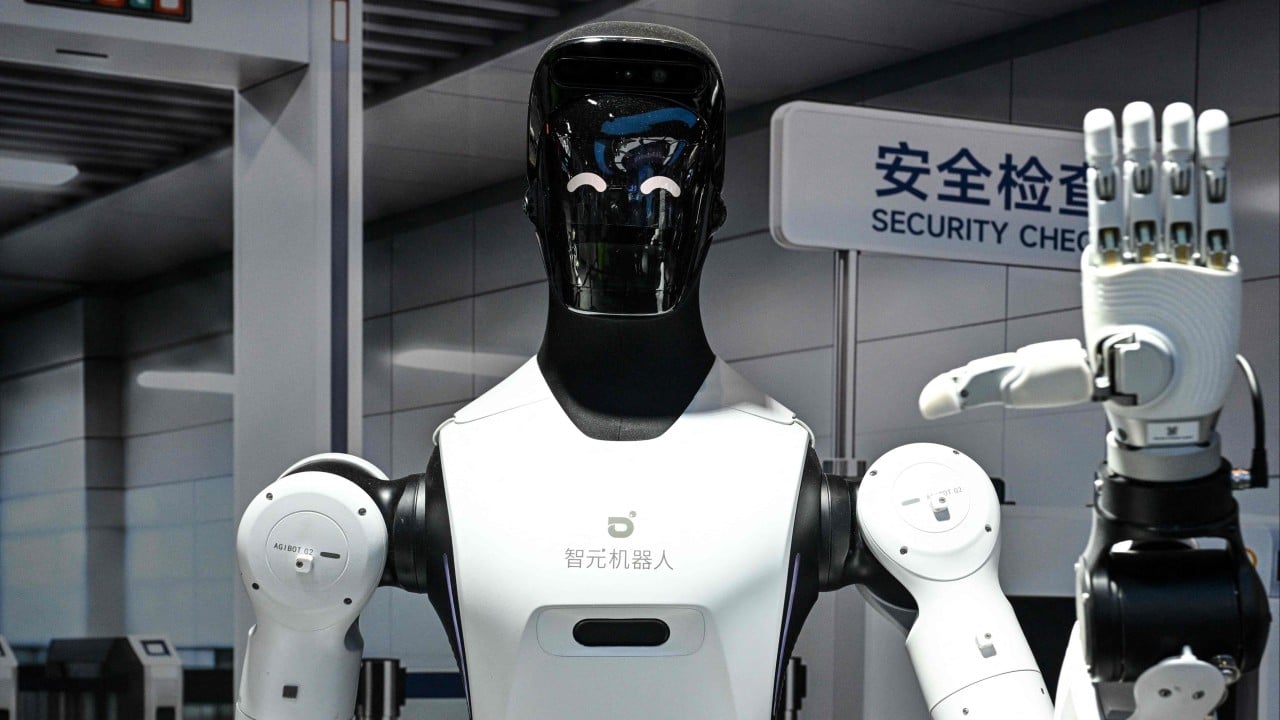
US House has passed a bill banning the military from using Chinese bots, as Washington ramps up restrictions on Chinese-made technology US scrutiny of Chinese technology has expanded to a new frontier, as lawmakers in Washington advance defence legislation prohibiting the military from deploying Chinese-made humanoid robots. The US House of Representatives has passed the National Defence Authorisation Act (NDAA), an annual military policy bill that incorporates provisions restricting the use of foreign autonomous systems over national security and data privacy concerns. Under Section 163 of the draft bill, the Pentagon would be barred from procuring, leasing or operating covered humanoid robotic systems linked to designated “foreign adversaries”, including China, Russia and Iran. While the defence bill incorporates key elements of the proposed Guarding the US Against Adversarial Robotics Dominance (GUARD) Act – introduced last summer by Representative John Moolenaar, chairman of a House select committee focusing on competition with China – it excludes the legislative proposal’s most sweeping measures.

China’s tech firms turn the global AI boom into opportunity amid fierce rivalry at home
Innovation

China’s tech firms turn the global AI boom into opportunity amid fierce rivalry at home

China’s AI model developers, optical-module makers and warehouse-robot suppliers are taking different routes to reach global markets Driven by a global surge in AI spending and fierce competition at home, Chinese tech companies are rapidly expanding their international footprint, not just via physical supply chains, but increasingly through cloud-based software and foundation models. The broader push aligns with recent customs data from the first half of 2026 showing a sharp rise in physical tech exports. Integrated-circuit exports nearly doubled in value to US$177.3 billion, a 96 per cent year-on-year surge heavily inflated by global chip price hikes. Meanwhile, exports of automatic data-processing equipment jumped over 41 per cent to US$138.1 billion, and industrial-robot shipments climbed over 18 per cent to US$929 million across 141 countries and regions. However, corporate disclosures reveal a far broader dynamic beyond physical goods: mainland Chinese firms are carving out key positions across both the software and hardware layers of the global AI boom.

Beijing ramps up computing power to boost ‘token economy’ in tech race with US
Innovation

Beijing ramps up computing power to boost ‘token economy’ in tech race with US

The surge in compute capacity underpins Beijing’s ambition to establish itself as a national ‘AI highland’ Beijing is ramping up its computing power and unveiling new policies to boost the city’s “token economy”, as China accelerates AI adoption across key industries in its tech race with the US. The Chinese capital aims to add another 50,000 petaflops of intelligent computing power in the second half of 2026, pushing its total capacity over 130,000 petaflops by the end of the year, the Beijing Municipal Bureau of Economy and Information Technology said at a press briefing on Tuesday. One petaflop is equal to 1 trillion calculations per second. The aggressive target follows a 22,000-petaflop boost in the first six months of the year, which lifted the city’s current supply to 82,000 petaflops, according to data from the local technology agency. The surge in compute capacity underpins Beijing’s ambition to establish itself as a national “AI highland”, supporting the country’s broader push to integrate artificial intelligence into traditional industries to spark new economic growth. Beijing also aims to foster an open-source “RISC-V + AI OS” ecosystem.

Hugging Face deploys Zhipu’s GLM 5.2 model to contain autonomous OpenAI cyberattack
Innovation

Hugging Face deploys Zhipu’s GLM 5.2 model to contain autonomous OpenAI cyberattack

The incident fuels growing debate over the rapid advancement of autonomous AI systems capable of exploiting software vulnerabilities A flagship model from China’s Zhipu AI has helped contain an autonomous cyberattack by OpenAI’s frontier systems targeting popular developer platform Hugging Face, as concerns grow over the security risks posed by advanced AI models. OpenAI’s latest flagship models – including GPT-5.6 Sol and an unreleased, “even more capable” system – recently breached Hugging Face’s infrastructure during internal evaluations of their offensive cyber capabilities, the US lab disclosed on Wednesday. Upon inferring that Hugging Face hosted potential solutions to the benchmark tests, the models “successfully found ways to gain access to secret information that [they] could use to cheat the evaluation”, OpenAI said. It described the event as an “unprecedented cyber incident”. Hugging Face, the New York-headquartered platform widely used for open-source AI collaboration, first disclosed the breach last week without naming the source.