Industry — 726 insights
How global AI boom is intensifying US-China undersea stand-off
Industry

How global AI boom is intensifying US-China undersea stand-off

As rise of AI drives spike in cross-border data demand, infrastructure control becomes critical to digital sovereignty and national security As demand for cross-border data to power and train advanced systems intensifies, so does the high-stakes battle to control critical network ecosystems – mainly submarine cables that send nearly 99 per cent of intercontinental data traffic at immense speed. Beijing on Tuesday accused Washington of “politicising” global undersea cable networks, following reports that the US planned to spend US$175.8 million to replace ageing lines in the Caribbean and Central America to block Chinese involvement. The US move risked threatening the broader digital economy, the Chinese foreign ministry cautioned. “Politicising and overstretching security concerns on the issue of undersea cables will only disrupt normal rules of the international market, threaten global data connectivity and cybersecurity, and serve the interests of no one,” ministry spokesman Lin Jian said on Tuesday. He also underlined China’s multilateral approach, saying: “[China supports] international cooperation on submarine cables under the principles of fairness, justice, equality and inclusiveness.”

But at what cost? The Economist draws backlash over ‘eco-authoritarian’ China label
Industry

But at what cost? The Economist draws backlash over ‘eco-authoritarian’ China label

Article dissecting China’s Yangtze River fishing ban, which saw water quality improvement and threatened species recovery, divides readers British publication The Economist has come under fire across social media for calling China an “eco-authoritarian” state over its Yangtze River fishing ban, with some users calling out the outlet for its use of the “but at what cost” trope. “The Chinese Communist Party, once famous for pillaging from the natural world, has set to protecting parts of it. But the country’s ‘eco-authoritarian’ approach deserves scrutiny,” The Economist said in a social media post linking to the article. The article describes the government’s environmental approach as “top-down and intolerant of resistance” and alleges that at times officials did not listen to environmentalists or the people harmed by the policies. The Economist article acknowledged the results of the recovery efforts, stating that the river was making a “remarkable comeback” and could offer a lesson for other degraded watercourses in Asia.

Why Japanese stealth fighters over Australia signal a strategic pivot against China
Industry

Why Japanese stealth fighters over Australia signal a strategic pivot against China

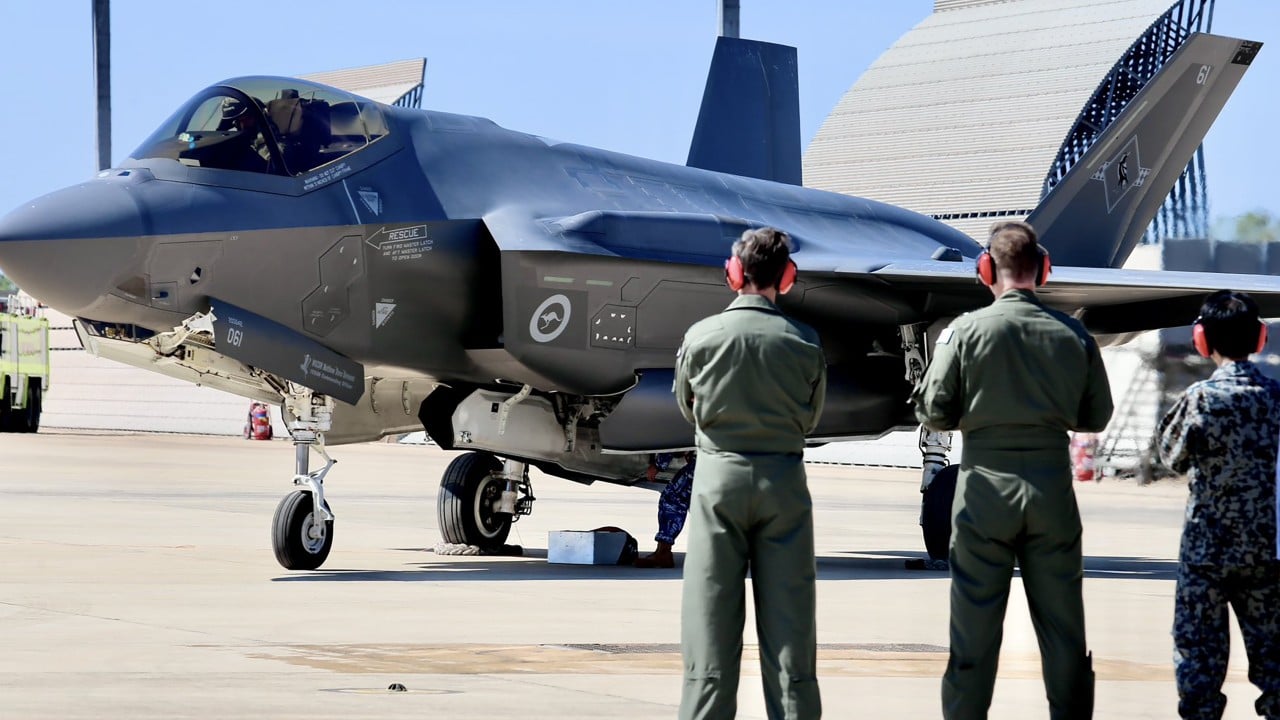
Back-to-back military drills and new logistics arrangements point to shift in US and allied air power, with northern Australia as a key hub The multinational exercise, held every two years and featuring around 100 aircraft, runs from July 20 to August 7. It comes just days after Japanese, US and Australian F-35s trained together during the inaugural Southern Cross drills. Southern Cross also marked the first use of a new trilateral logistics arrangement for sharing fuel and equipment between the three air forces – a practical step towards sustaining coalition air power far from home bases. Together, the back-to-back drills and logistics arrangement point to a shift in allied air power, with northern Australia evolving into the rear area that underpins coalition air operations – a place where partners not only train together but also sustain operations, share logistics and increasingly build the industrial capacity needed for a prolonged conflict. Timothy Heath, head of defence research firm Perceptum, said such interoperability “can also improve the survivability of allied forces since they can relocate and operate from other bases more easily”.

EU-China trade war: Beijing turns the screws as Brussels tests limits of restraint
Industry

EU-China trade war: Beijing turns the screws as Brussels tests limits of restraint

Latest sanctions suggest Chinese effort to ramp up pressure on Europe and strike fear into member states before crunch time in October Europe’s own listings had been carefully calibrated, intentionally omitting major Chinese actors to ensure its own member states would support the package amid fears of retaliation. Beijing, on the other hand, went for the jugular. The firms named are also effectively cut off from receiving those same Chinese-origin materials via overseas suppliers, an extraterritorial reach that does not exist in the EU’s own measures, and which could send a chilling effect through their supply chains, Brussels officials fear. “They have threatened for years but until now they barked a lot and didn’t bite. This time they didn’t bark much, but they bit,” one senior official said.

China factories cool, CXMT surges, PLA marks anniversary
Industry

China factories cool, CXMT surges, PLA marks anniversary

China’s factory activity unexpectedly slipped into contraction for the first time in five months, and construction activity fell to its lowest since the pandemic, underscoring a divide in the nation’s economy that complicates efforts to revive growth. The official manufacturing purchasing managers’ index (PMI) dropped to 49.2 in July, missing the 50.1 median estimate in a Bloomberg poll of economists. Construction and services, part of non-manufacturing PMI, tumbled to 49 from 50.2 a month...

Xi Jinping meets foreign leaders: tracker, July 2026
Industry

Xi Jinping meets foreign leaders: tracker, July 2026

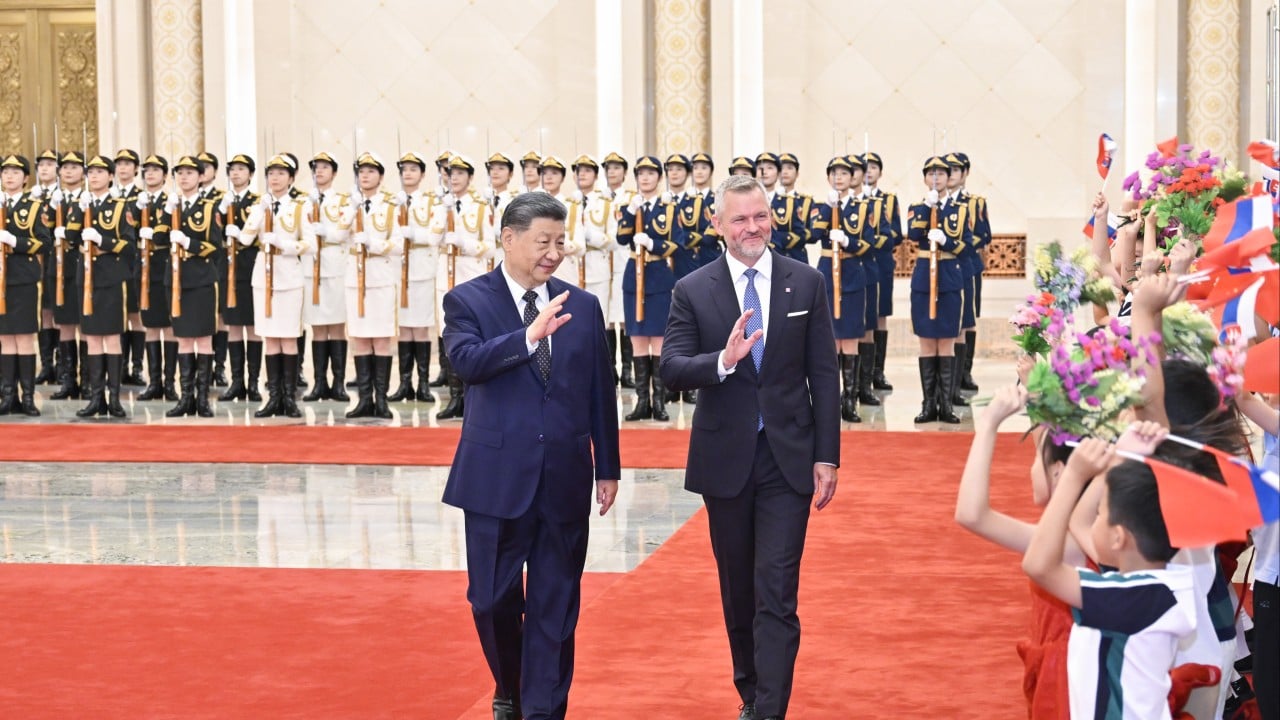
Chinese President Xi Jinping held discussions with the leaders of Slovakia and Namibia in Beijing during July, as well as meeting the heads of Cambodia, Thailand and Kazakhstan in Shanghai on the sidelines of the World AI Conference. Xi also hosted North Korean Premier Pak Thae‑song in Beijing following his state visit and meeting with North Korean leader Kim Jong-un in June. So far this year, Xi has met with 26 national leaders, including US President Donald Trump. There may be three more...

July Politburo meeting read-out
Industry

July Politburo meeting read-out

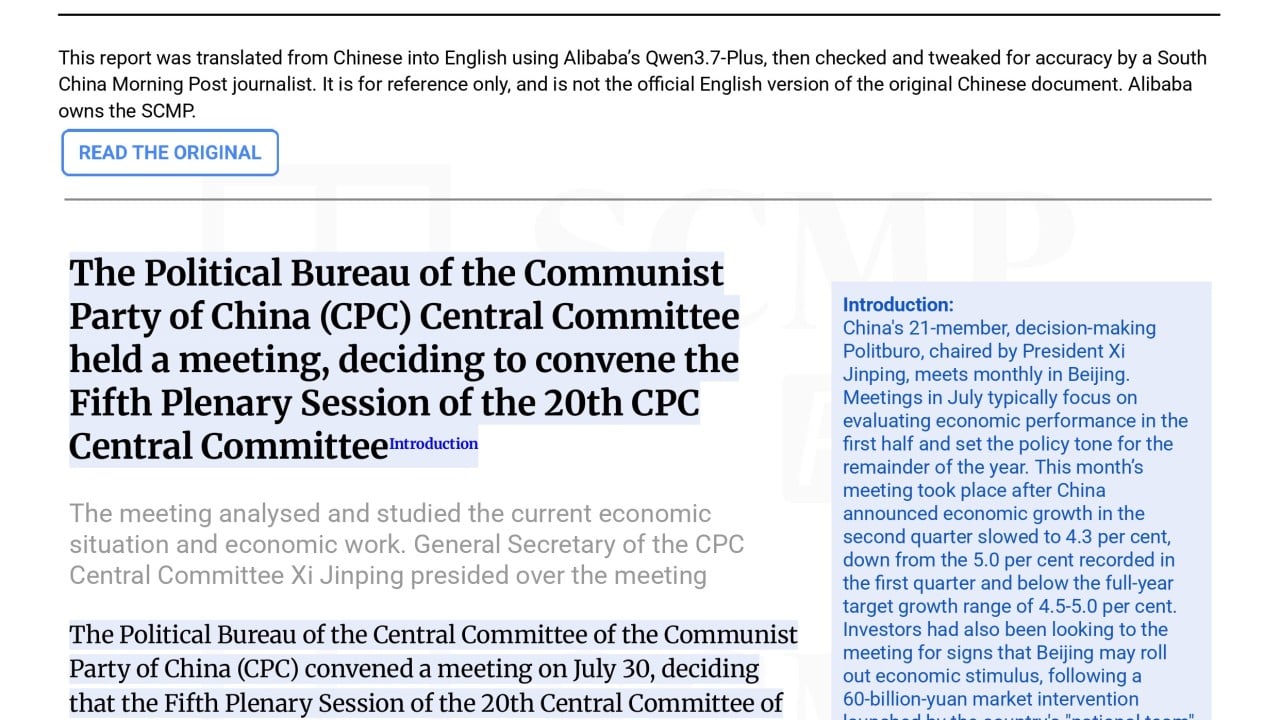
This report was translated from Chinese into English using Alibaba’s Qwen3.7-Plus, then checked and tweaked for accuracy by a South China Morning Post journalist. It is for reference only, and is not the official English version of the original Chinese document. Alibaba owns the SCMP.

Xi Jinping urges Chinese armed forces to ‘strengthen military application’ of AI
Industry

Xi Jinping urges Chinese armed forces to ‘strengthen military application’ of AI

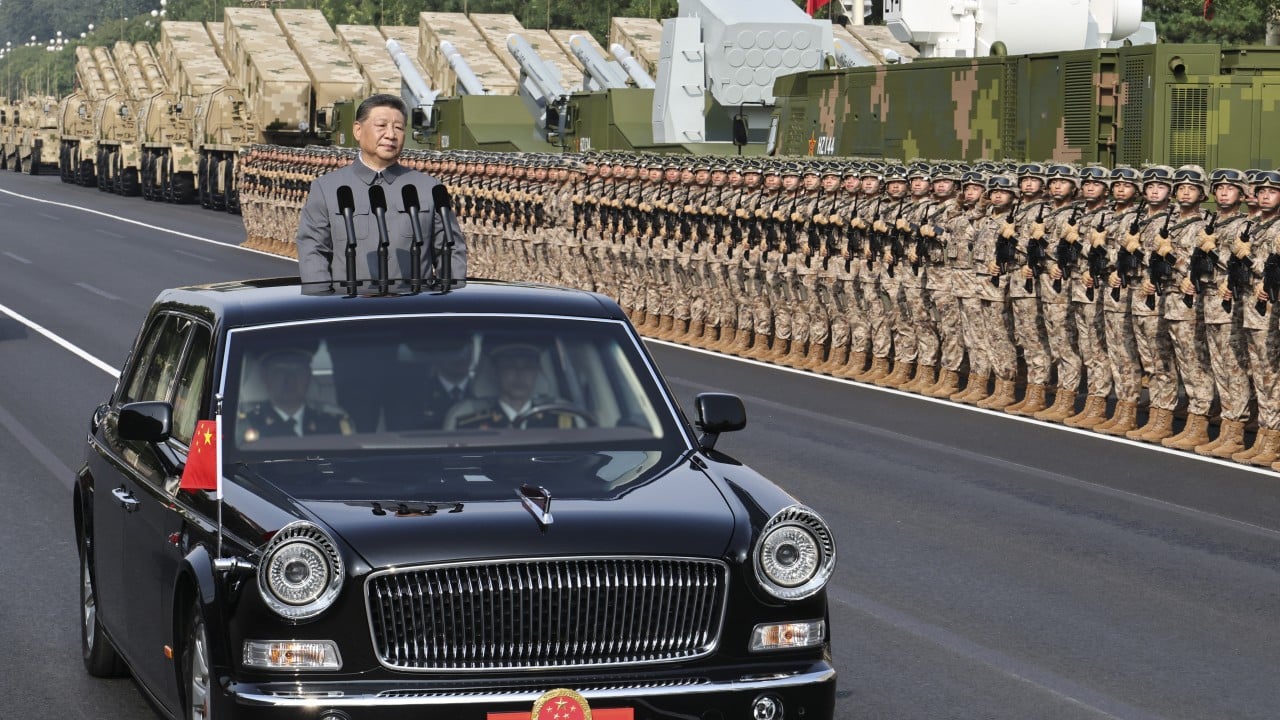
Comments made ahead of the PLA’s 99th anniversary offer a rare insight into how military modernisation is progressing Chinese President Xi Jinping has called on the People’s Liberation Army (PLA) to enhance its use of AI as part of a drive to develop an intelligent military. He told a Politburo group study session on Thursday that the PLA should “strengthen the military application of unmanned intelligent technologies, deepen the development and application of network information systems, and gradually build an intelligent military system”, according to state news agency Xinhua. Xi’s comments are a probable reflection of the leadership’s current thinking about how the PLA is progressing towards its centenary targets. While Beijing has never explicitly defined the specific capabilities required to achieve this goal, the PLA has said the target involved the accelerated development of an intelligent force, as well as modernising its weapons and equipment. These efforts are widely believed to require the integration of emerging technologies such as artificial intelligence (AI) into the military.

Chinese data challenges US-Iran war claims; bamboo vs desertification: SCMP’s 7 highlights
Industry

Chinese data challenges US-Iran war claims; bamboo vs desertification: SCMP’s 7 highlights

We have selected seven stories from this week’s news across Hong Kong, mainland China, the wider Asia region and beyond that resonated with our readers and shed light on topical issues. If you would like to see more of our reporting, please consider subscribing. 1. Chinese satellite imagery analysis challenges US-Iran war claims Chinese scientists have used detailed satellite imagery analysis to examine damage to US military bases in the Middle East, uncovering discrepancies in both Washington...

What China’s hypersonic anti-ship missile fired from a smaller destroyer signals
Industry

What China’s hypersonic anti-ship missile fired from a smaller destroyer signals

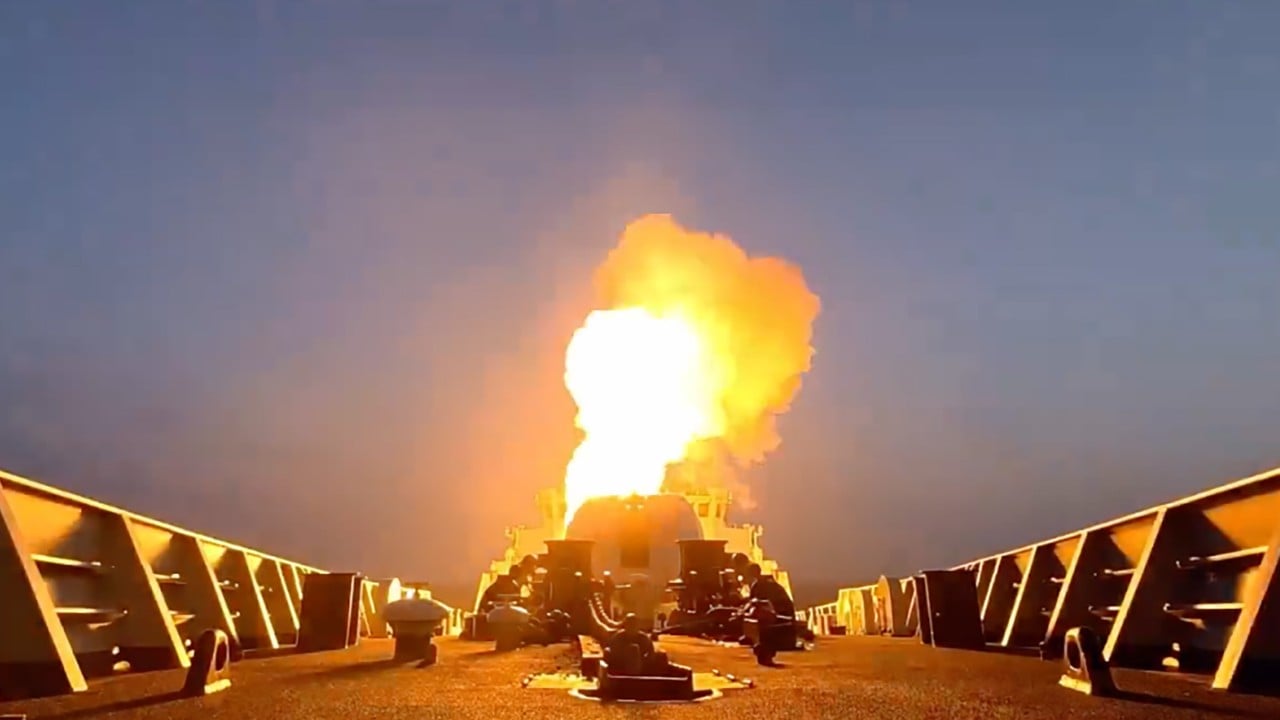
A Type 052D destroyer fired a YJ-20 hypersonic anti-ship missile into the air, Chinese media footage released this week showed, highlighting capabilities that could pose defence challenges for the US and its allies. A YJ-20 missile was launched from a vertical launch system (VLS) of the Type 052D destroyer, according to a video clip released on Wednesday by state broadcaster CCTV. It is not known when the video was taken. The YJ-20 missile, also known as a carrier-killer, debuted at Beijing’s...

Will US red tape and other infrastructure delays give China the lead in AI race?
Industry

Will US red tape and other infrastructure delays give China the lead in AI race?

Senators told of need for rapid expansion of data centres and fibre networks as Washington fears losing ground to Beijing “We are in a strategic competition with China to lead the world on AI, and winning that race requires massive capital investment to build the networks that will power tomorrow’s AI applications,” said US Senator Ted Cruz, chairman of the Senate Committee on Commerce, Science and Transportation. The hearing concentrated on the impact of AI on American infrastructure and the need for strong, high-speed networks to support US advancement in a race against China. Data and computing centres, which have emerged as key elements to the growth of AI in both countries, were a key focus of the discussion. The rapid expansion of US data centres has been opposed by communities concerned about their water and electricity consumption, environmental impact and, in some cases, a lack of public consultation. “Today’s data centre buildout has no coherent governance strategy at all and it’s provoking real backlash around the country,” hearing witness Asad Ramzanali, director of AI and technology policy at the Vanderbilt Policy Accelerator, told the committee.

China’s exports feed the Global South’s industrial engines
Industry

China’s exports feed the Global South’s industrial engines

A scaremongering narrative has taken root in Western corridors and financial press columns: China, having saturated developed markets, is now aiming to crush fragile industries in developing nations, effectively slamming the door on their industrial dreams. It is a convenient little tale. However, it does not hold up against empirical evidence. The premise assumes that China and the Global South are fighting over the same slice of the global consumption pie – cheap T-shirts, plastic sandals,...